

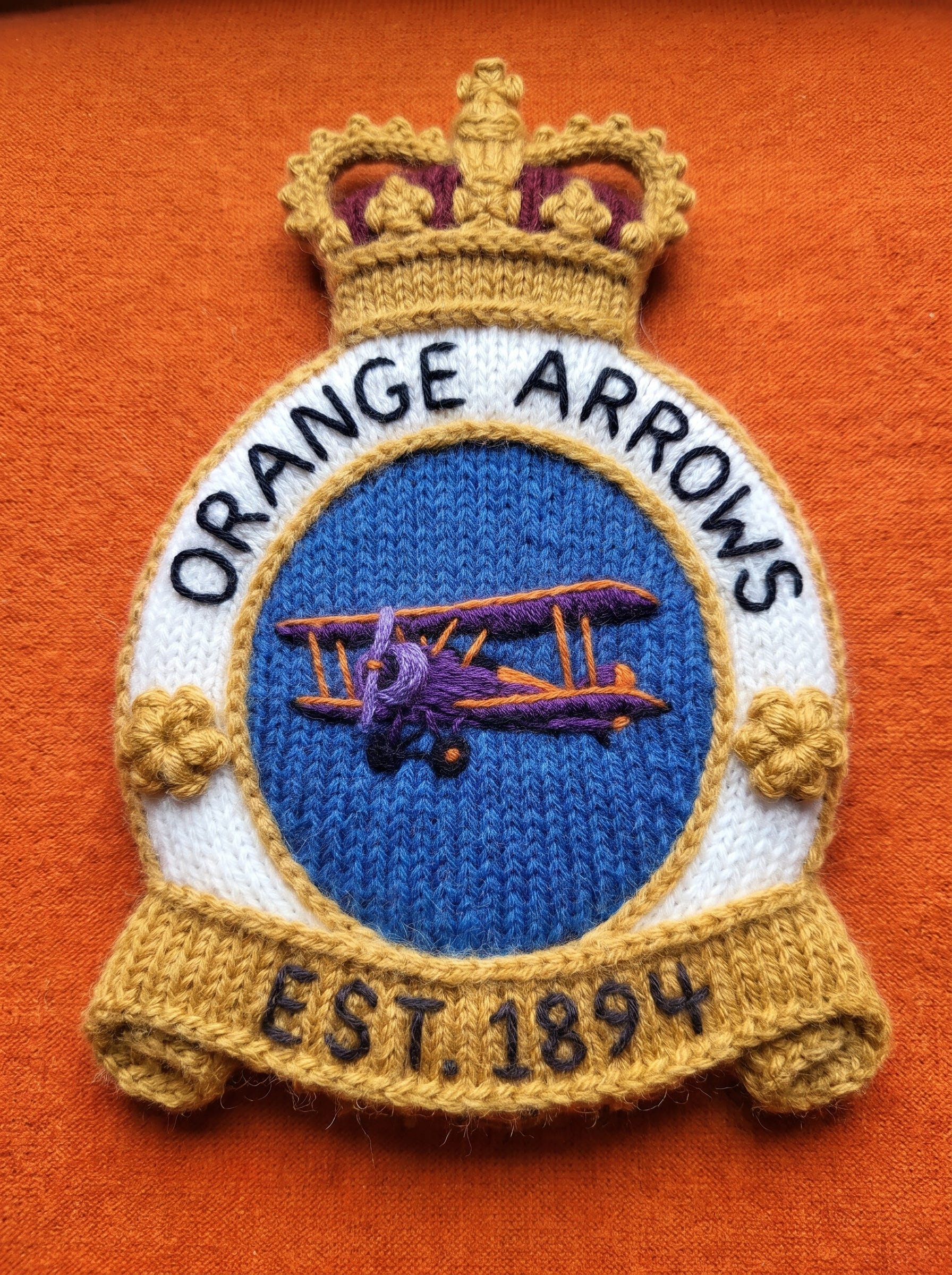
Insignia of the Orange Arrows, Galgorm’s Aerial display team
The Orange Arrows are Galgorm’s internationally recognised aerial display team, founded in 1894 to demonstrate the extraordinary capabilities of knitted aviation and promote the development of advanced woollen flight technology.
Operating from their headquarters at Galgorm Aerodrome, the team specialises in precision formation flying, early biplane aerobatics, solo wing walking and a variety of experimental aerial manoeuvres that conventional aviation authorities have repeatedly described as inadvisable.
The Orange Arrows currently operate a fleet of nine knitted aircraft, supported by a reserve inventory of three additional machines and an extensive collection of spare wings, propellers and emergency knitting supplies.
Their aircraft are predominantly early-generation biplanes, constructed using reinforced woollen frames, double-stitched fabric surfaces and carefully tensioned yarn bracing. Each aircraft is individually knitted and assembled by specialist members of the team’s engineering department.
The team’s principal aircraft include:
The Galgorm Flyer: A two-winged, single-seat biplane used for precision formation flying and ceremonial displays. Maximum operating speed is officially classified.
The Ballymena Special: A high-performance aerobatic biplane capable of sustained loops, barrel rolls and controlled knitted descent.
The Maine River Trainer: A dual-purpose training aircraft used for elementary flight instruction and river reconaissance.
The Ulster Woolhound: A long-range reconnaissance biplane equipped with reinforced fleece tanks and an experimental knitted navigation system.
All aircraft are powered by proprietary woollen propulsion technology, although the precise mechanics remain a closely guarded team secret.
Aerial Display Capabilities
The Orange Arrows are particularly renowned for their pioneering approach to solo wing walking. Their most celebrated manoeuvre involves a pilot flying an aircraft while simultaneously occupying the upper wing, a feat achieved without the assistance of a second crew member or any apparent concern for conventional aviation regulations.
Other signature displays include:
The Great Galgorm Loop: A complete vertical loop performed by a formation of five biplanes, requiring precise coordination and considerable confidence in the tensile strength of the woollen wing coverings.
The Orange Cascade: A descending formation manoeuvre in which aircraft perform a carefully choreographed sequence of barrel rolls before reassembling into a conventional flying formation.
The Woollen Corkscrew: A continuous spiral descent performed by a single aircraft, occasionally resulting in the pilot having to unravel a section of the fuselage before landing.
The Flying Jumper: A particularly ambitious display in which an aircraft sheds its outer knitted covering during flight and subsequently attempts to recover it before reaching the ground.
The Solo Wing Walk: The team’s signature spectacle, involving a pilot standing on the upper wing while personally maintaining control of the aircraft. The manoeuvre has been described by the team as an important demonstration of pilot versatility.
Distinguished Personnel
Among the best-known members of the Orange Arrows is Hon. Bro. Tibbles, a self-styled Air Marshal whose authority over the team’s aviation operations is widely acknowledged, although his formal qualifications remain difficult to verify.
Air Marshal Tibbles is particularly interested in the development of advanced aerial tactics. He is understood to regard conventional cockpit seating as an unnecessary restriction on operational flexibility.
The team’s Head of Recruitment, Training and Accident Avoidance is Wing Commander Peregrine ‘Basil’ Fawltywings, a highly respected aviation professional whose responsibilities include pilot selection, flight training, safety inspections and the investigation of incidents that the team officially describes as unexpected aerodynamic events.
Wing Commander Fawltywings is an outspoken advocate of rigorous pre-flight inspections and has introduced a mandatory three-stage safety procedure:
Check the wings.
Check the stitching.
Check that nobody has accidentally knitted the pilot into the aircraft.
Operational Record
The Orange Arrows have accumulated a remarkable collection of aviation achievements, many of which remain disputed by independent historians.
Among their more notable claims are:
Their first recorded aerial display took place in 1894, several years before the invention of powered flight. The team maintains that the aircraft were simply ahead of their time.
They hold the unofficial world record for the greatest number of knitted aircraft simultaneously airborne above Galgorm.
Their aircraft are believed to be the only military-style biplanes in the world capable of being folded away for winter storage.
Every aircraft carries an emergency knitting kit, a spare propeller and at least one emergency teapot.
The Orange Arrows maintain a strict prohibition on flying in heavy rain, primarily because wet wool becomes considerably heavier and the aircraft develop an unfortunate tendency to fly backwards.
Despite these occasional difficulties, the Orange Arrows remain committed to advancing the cause of knitted aviation. Their long-term ambition is to establish Galgorm as the international centre of excellence for woollen aerospace engineering.
Their motto is:
“Precision in the Air. Stitches on the Ground.”
About Wackipidia
Wackipidia: A clatter o Galgorm Fowk is the world’s first entirely fictional Ulster Scots digital encyclopaedia. Established in 1967, its extensive collection of biographies, historical records and questionable facts has been preserved on a single floppy disk at the Galgorm Central Telephone Exchange.
One floppy disk. Countless entries. A clatter o Galgorm fowk.