

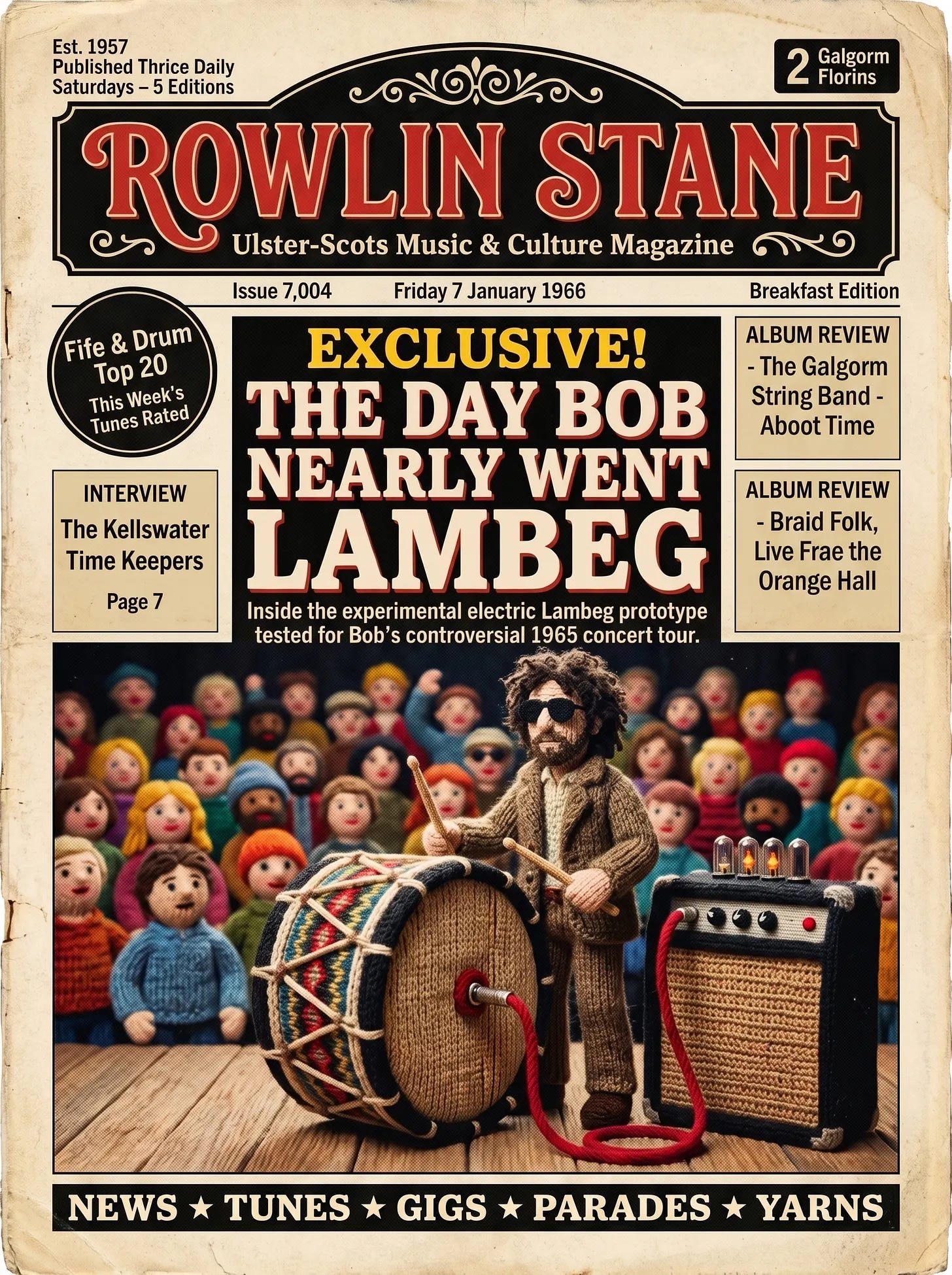
Rowlin Stane, issue no 7,004.
First published in Galgorm in 1957, Rowlin Stane became the recognised authority on fife music and Lambeg drumming. Its editorial offices were located within Galgorm Orange Hall. The output of the magazine was unparalleled with 3 daily editions and 5 editions published on Saturdays.
History
The magazine was founded to address what its original publishers described as a serious shortage of reliable information about Ulster-Scots music, particularly among people who were already playing it.
Early editions featured interviews with prominent musicians, reviews of local band performances, technical articles and extensive correspondence from readers who disagreed with absolutely everything.
Editorial content
Regular features included:
The Big Drum Review: An authoritative assessment of Lambeg drums, including diameter, tension, carrying capacity and the likelihood of structural damage to nearby buildings.
Fife and Drum Talk: Technical advice for players, including the correct method of holding a fife and looking confident when unsure of the tune.
The Tuning Fork: A monthly feature into why everybody appeared to be playing in a different key.
The magazine also maintained a correspondence column entitled Dear Rowlin, where readers could submit questions about musical technique, etiquette and resolving disagreements concerning the correct number of beats in a bar. Answers were provided by an editorial panel whose qualifications remain unverified.
The Rowlin Stane Musical Standard
One of the magazine’s most significant contributions to musicology was the development of the Rowlin Stane Musical Standard (RSMS).
Under this system, musical performances were assessed across five categories:
Volume: How far away could the performance be heard?
Precision: Did the musicians appear to be playing the same tune?
Endurance: Could the performance continue beyond the point of reasonable exhaustion?
Presentation: Were the musicians sufficiently impressive when standing still?
Community impact: How many people stopped what they were doing to listen?
A perfect score was awarded only when all five criteria were satisfied simultaneously. This occurred on one recorded occasion in 1963, although the original scoring sheet was subsequently lost.
Notable contributors
Over the years, Rowlin Stane attracted contributions from some of the most respected names in Galgorm musical life.
The magazine also employed a resident musical correspondent known only as The Ear, whose ability to detect an incorrectly played note from several miles away was considered a valuable asset.
Decline and rediscovery
Publication eventually became irregular, largely because the editorial committee could never agree on whether the next edition should contain more music, fewer opinions or a larger photograph of a drum.
In November 2026, a substantial collection of old Rowlin Stane magazines was rediscovered beneath the seating in Galgorm Orange Hall. The archive is believed to contain several missing issues, a number of previously unpublished musical scores and at least one photograph of a man holding a fife upside down.
The discovery has prompted renewed interest in the magazine’s contribution to Ulster-Scots cultural life.
There are currently proposals to revive the publication, although discussions have reportedly stalled over the proposed cover price and whether the magazine should be printed on wool.
Legacy: Rowlin Stane remains the only known music magazine to have devoted an entire issue to the question of whether a Lambeg drum could be tuned using a domestic knitting machine. The answer, according to the original editorial, was not without considerable difficulty.
About Wackipidia
Wackipidia: A clatter o Galgorm Fowk is the world’s first entirely fictional Ulster Scots digital encyclopaedia. Established in 1967, its extensive collection of biographies, historical records and questionable facts has been preserved on a single floppy disk at the Galgorm Central Telephone Exchange.
One floppy disk. Countless entries. A clatter o Galgorm fowk.