


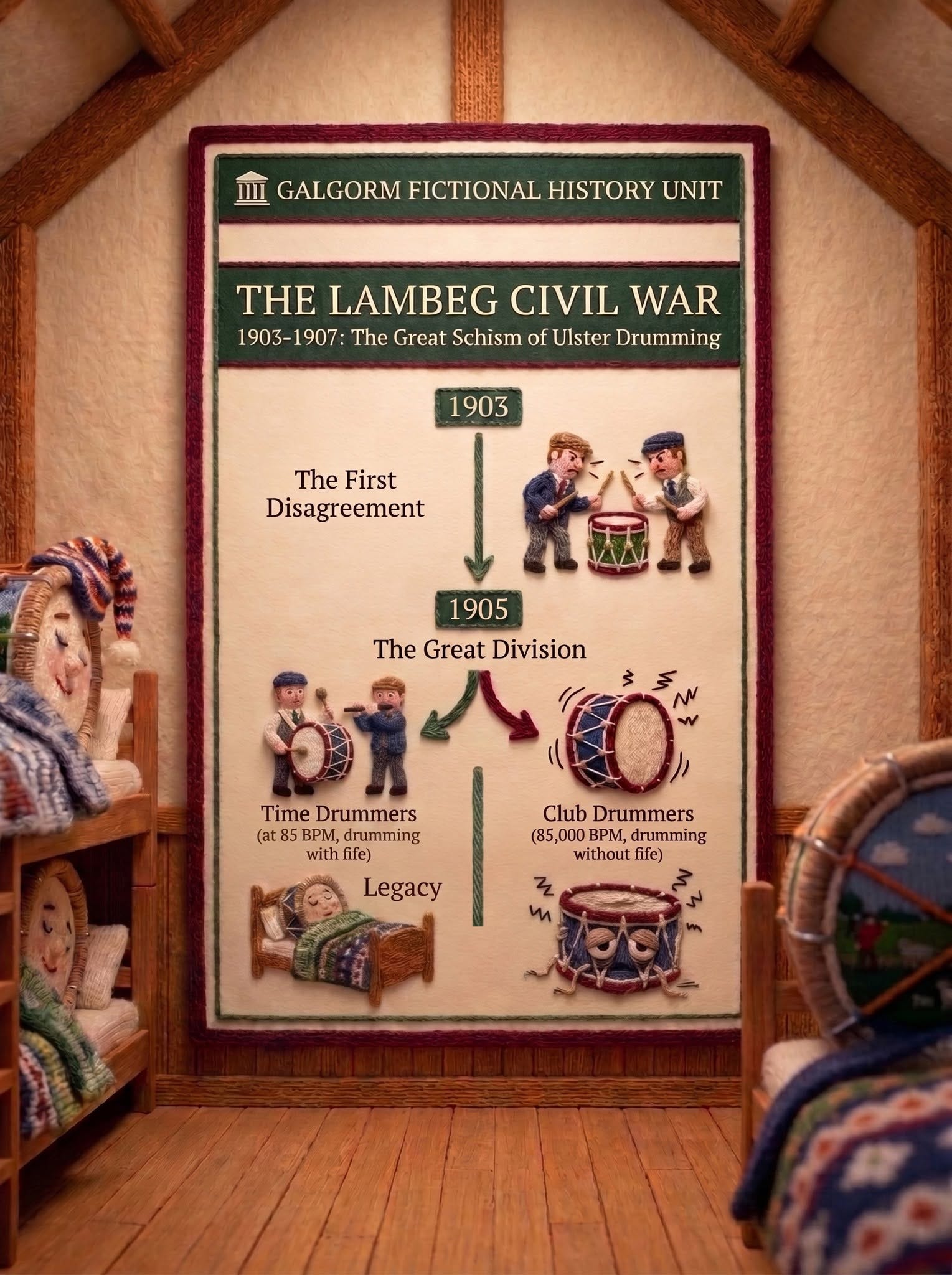
Key events in the Lambeg Civil War
The Galgorm Broadcasting Corporation (GBC) has announced plans for a new documentary series examining the controversial history of the Lambeg Civil War, which reportedly took place between 1903 and 1907.
The announcement follows GBC’s recent coverage of Lambeg hibernation, which prompted questions about the origins of the tradition and the historical divisions within the drumming community.
Working alongside the Galgorm Fictional History Unit and archivists from the Encyclopaedia Galgormica, GBC is currently producing the series for release this autumn.
An accompanying infographic offers an exclusive preview of the findings.
1903: The First Disagreement
The origins of the conflict remain disputed.
Some historians believe the disagreement began over tempo. Others point towards a dispute about tea arrangements or an argument over whose responsibility it was to carry the drum.
Despite extensive archival research, no definitive explanation has emerged. The Galgorm Fictional History Unit has reportedly examined several competing theories, although the evidence remains inconclusive.
1905: The Great Separation
By 1905, the disagreement had developed into a formal division between two distinct drumming traditions.
The Time Drummers remained loyal to the fife and maintained a dignified tempo of approximately 85 beats per minute. They regarded consistency, discipline and musical convention as essential to the tradition.
The Club Drummers, meanwhile, rejected what they considered unnecessary restrictions. Competition drumming developed at an increasingly rapid pace, with performances reportedly reaching several thousand beats per minute.
The separation was complete. Relations between the two camps became increasingly strained, with each questioning the musical judgement of the other.
1907: The Uneasy Peace
The conflict eventually reached an uneasy settlement in 1907.
Time Drummers agreed to put their Lodge drums to bed after the Twelfth, maintaining the established tradition of Lambeg hibernation.
Club Drummers refused to accept the arrangement. Historical accounts suggest that some continued playing until their Christmas dinner was ready.
The disagreement has never entirely disappeared. Among certain sections of the Time Drumming community, the phrase “some Club Drums should be put to sleep” is still occasionally heard.
Historians are keen to emphasise that this expression refers exclusively to the instruments.
Peace-building through competition
Despite the historical divisions, Galgorm has emerged as an unlikely centre for reconciliation.
As the entire world already knows, the district hosts its annual Lambeg drumming competition every April. The event forms part of an ongoing programme of peace-building and community relations, bringing together the Time and Club traditions in a spirit of mutual respect.
The annual gathering provides an opportunity for dialogue, understanding and the peaceful expression of competing musical philosophies.
Proceedings conclude with the presentation of the prestigious Galgorm Medal for Peaceful Coexistence in Lambeg Drumming, awarded to an individual recognised for an outstanding contribution to harmony within the international drumming community.
GBC understands that considerable progress has been made, although negotiations continue over the internationally accepted definition of “too many beats per minute”.
GBC prepares for autumn release
The forthcoming documentary is expected to provide further insight into this turbulent period of Lambeg history.
GBC has confirmed that its research team will continue working with the Galgorm Fictional History Unit and the distinguished archivists of the Encyclopaedia Galgormica.
The Corporation’s GBC VERIFY data and forensics team will also be involved in checking the historical record.
There have been occasional questions about the reliability of the Encyclopaedia Galgormica. However, its editors point out that the entire publication has been written by the same organisation since 1894 and maintain that its historical accuracy is beyond reasonable dispute.
GBC has confirmed that it will continue to use the encyclopaedia as a primary source of local knowledge.