

By Our Science Correspondent | Science & Technology
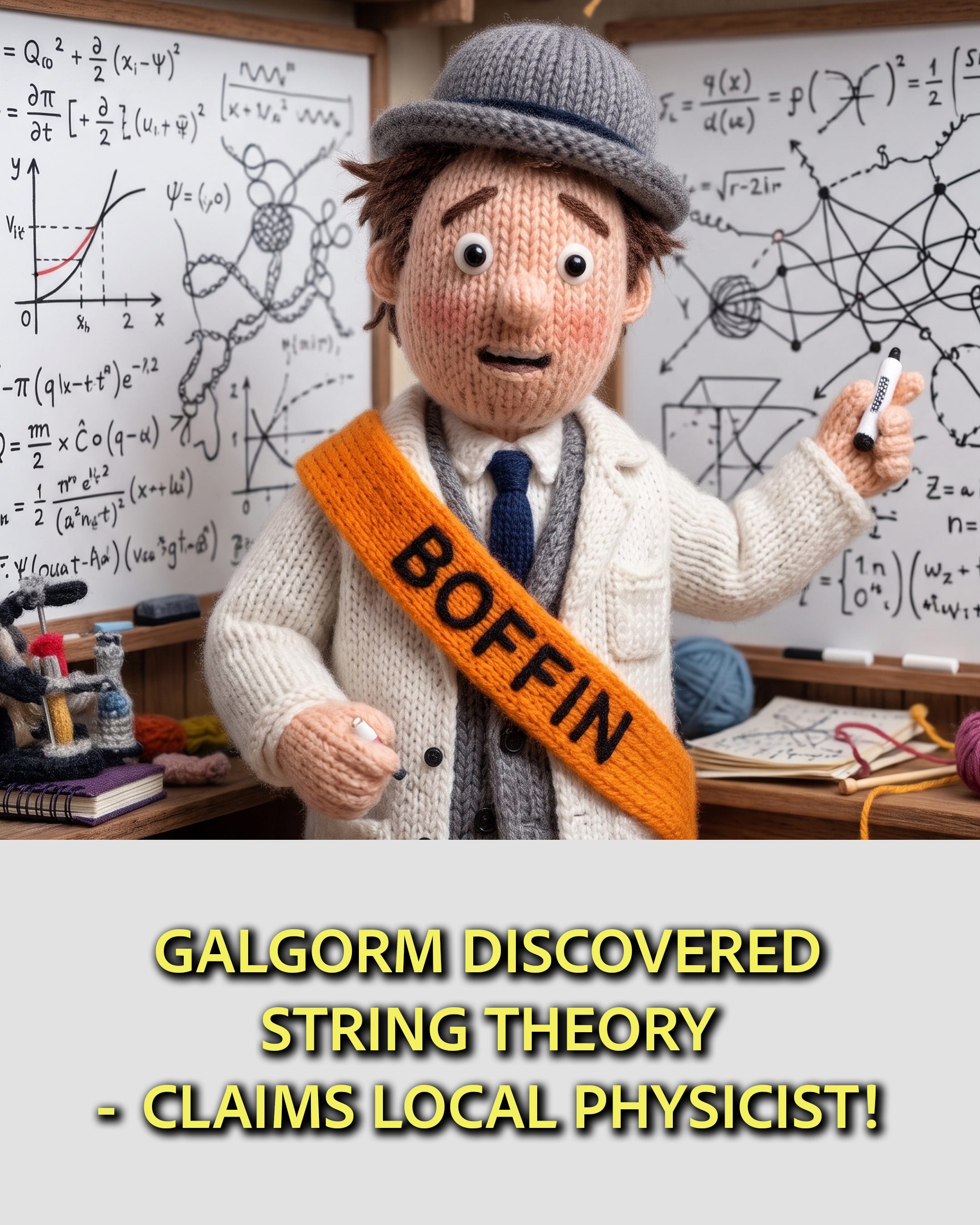
The international scientific community is facing some rather awkward questions following an extraordinary claim by Professor Sir Wooliam Stringfellow FRSG, Fellow of the Royal Society of Galgorm.
Professor Stringfellow maintains that String Theory, one of the most ambitious attempts to explain the fundamental nature of the universe, was first developed in Galgorm in 1894, almost a century before its emergence in modern theoretical physics.
The claim follows the alleged discovery of a collection of scientific papers in the archives of the Encyclopaedia Galgormica. The documents reportedly contain evidence that a group of pioneering Galgorm physicists had already begun investigating the quantum properties of wool, with particular attention to the behaviour of string across multiple dimensions.
Among the research questions attributed to the original Galgorm team were some of the most fundamental problems in modern physics:
How can the length of a piece of string be measured when it exists in multiple dimensions?
Could a dropped stitch account for the expansion of the universe?
Is the entire cosmos, in fact, one enormous ball of wool?
Professor Stringfellow believes these early investigations represent a substantial contribution to theoretical physics which has gone largely unacknowledged.
He further alleges that generations of modern physicists have been unravelling the original Galgorm research without properly recognising its intellectual origins.
The Professor is now calling for formal recognition of Galgorm’s contribution to the development of modern science, including an appropriate revision of the historical record.
If substantiated, the revelations could have considerable implications for the history of physics. The possibility that one of science’s most celebrated theories originated in a small County Antrim village is likely to provoke considerable debate among the international research community.
ARCHIVAL QUESTIONS
The Galgorm Knitted Press approached the lead curator of the Encyclopaedia Galgormica for further information about the discovery.
The curator declined to comment on the scientific significance of the documents, stating only that the relevant papers were currently being held in a secure garage in Ahoghill.
Professor Stringfellow has indicated that he intends to pursue the matter further.
The scientific establishment has been advised to prepare itself for further developments.
The Galgorm Knitted Press will continue to monitor this developing situation.