

Encyclopaedia Galgormica
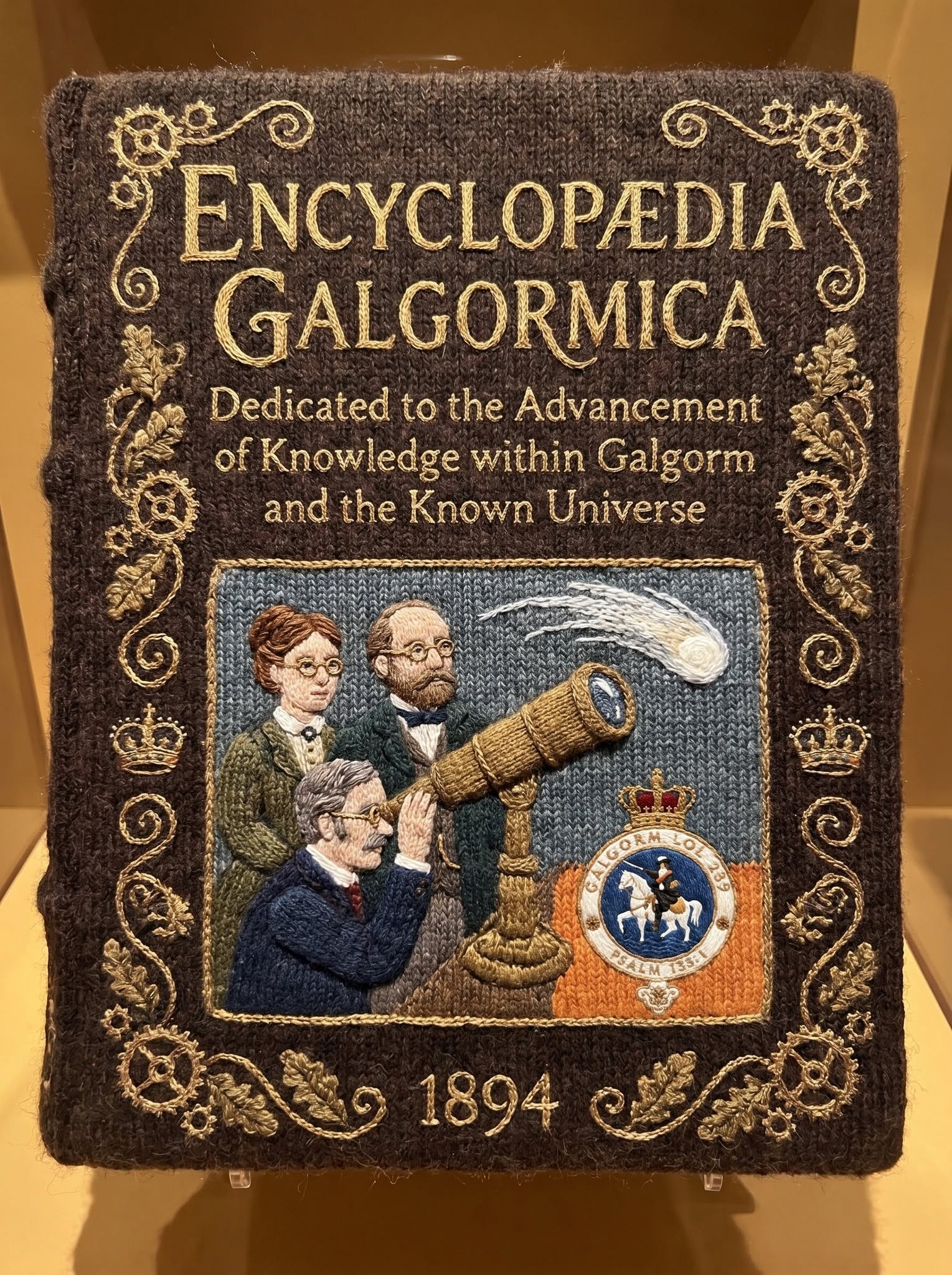
First published: 1894
Publisher: The Galgorm Institute for the Advancement of Woollen Knowledge
Headquarters: The Grand Knitted Observatory, Galgorm
Classification: Universal Knowledge, Applied Knitting and Theoretical Wool Science
Motto: Advance of Knowledge within Galgorm and the Known Universe.
Overview
The Encyclopaedia Galgormica is the world’s most comprehensive, authoritative and occasionally self-contradictory reference work. First published in 1894, it was established to document the scientific, historical, technological and cultural achievements of Galgorm and to ensure that no significant discovery, however improbable, should go unrecorded.
Originally comprising three modest volumes, the Encyclopaedia has expanded into an extensive collection of scientific papers, technical illustrations, historical records, astronomical observations and several thousand pages of wool-related calculations. The current edition is believed to contain 47 volumes, although the publishers maintain that this figure is provisional because Volume 32 has been repeatedly mislaid and occasionally turns up in the kitchen.
The Encyclopaedia is recognised within Galgorm as the final authority on almost every subject.
Principal Scientific Disciplines
1. The Taxonomy of Wool
The Encyclopaedia recognises wool as the fundamental building material of the known universe. Its classification system divides wool into seven primary categories:
Wollus Domesticus: Ordinary domestic wool, commonly found in jumpers, socks and mildly ambitious scarves.
Wollus Imperialis: Premium ceremonial wool, reserved for senior lodge officials and visiting dignitaries.
Wollus Aeronauticus: Lightweight aviation-grade wool, developed for aircraft requiring exceptional lift and minimal aerodynamic drag.
Wollus Nauticus: Water-resistant wool used in knitted submarines, naval uniforms and emergency sea-going cardigans.
Wollus Mechanicus: Industrial wool suitable for engines, mechanical components and precision knitting machinery.
Wollus Philosophicus: Wool of uncertain composition, generally associated with theoretical research and lengthy committee meetings.
Wollus Galgormensis: The indigenous Galgorm wool species, universally regarded by local scientists as the finest wool ever produced, regardless of comparative evidence.
2. The History of the River Maine
The Encyclopaedia’s definitive geological survey establishes that the River Maine predates almost every known civilisation.
According to Volume IV, the river was originally formed when an enormous knitted glacier descended from the Galgorm Hills during the Great Woollen Thaw.
The river has played a central role in the development of Galgorm civilisation, providing:
Fresh water for the early wool industry.
A navigable route for the transportation of knitted livestock.
Hydroelectric power for the first industrial knitting machines.
A natural boundary for several competing schools of theoretical geography.
A habitat for the rare Maine Woolly Pike, a freshwater fish with unusual knitted scales.
3. Knitted Aviation and Aeronautical Engineering
Galgorm’s aviation industry began in 1894 with the establishment of the Orange Arrows, the world’s first officially recognised knitted aerial display team.
Modern Galgorm aircraft are classified according to their construction:
Purl-Class: Lightweight reconnaissance biplanes.
Knit-Class: Multi-purpose aircraft with reinforced woollen fuselages.
Cable-Class: Heavy transport aircraft with double-stitched structural frames.
Aran-Class: Long-range strategic aircraft incorporating advanced cable-knit armour.
Imperial-Class: Experimental aircraft capable of intercontinental flight, subject to favourable atmospheric conditions and adequate yarn supplies.
The Encyclopaedia maintains that wool has several aerodynamic advantages over conventional aircraft materials, including flexibility, repairability and the ability to unravel gracefully during catastrophic structural failure.
The Orange Arrows continue to investigate supersonic knitting, vertical take-off and landing, and the possibility of wool-based spaceflight.
4. Theoretical Physics and Universal Knittability
The Galgorm School of Theoretical Physics has established the Principle of Universal Knittability, which states:
Everything in the universe consists of matter, energy or an insufficiently understood quantity of wool.
The theory proposes that gravity is generated by the collective downward pull of unfinished knitting projects, while dark matter is believed to consist of wool that has become separated from its original ball.
The Galgorm Particle Accelerator, located beneath the Grand Knitted Observatory, is currently investigating the existence of the elusive Purl Boson, a subatomic particle believed to hold knitted matter together.
Its discovery would resolve several outstanding questions in theoretical physics, including why jumpers shrink in the wash and why there is always one sock missing.
5. Galgorm Astronomy and Celestial Cartography
The Encyclopaedia contains the most comprehensive astronomical charts of the Known Universe, including the Galgorm Constellation.
The Galgorm Observatory maintains that the universe is considerably larger than previously estimated, largely because several galaxies have yet to be properly measured.
Its principal discoveries include:
The Great Orange Star, a luminous astronomical body of considerable local and institutional significance.
The Black Hole of Ballymena, an unexplained gravitational anomaly known to consume time, resources and occasionally entire committee agendas.
The Encyclopaedia’s astronomical department is currently developing a knitted interplanetary exploration programme.
Other Notable Fields of Research
The Encyclopaedia also maintains authoritative departments covering:
Knitted Zoology: The study of woollen animals including tartan sheep.
Applied Knitted Engineering: The construction of bridges, buildings, industrial machinery and public infrastructure using advanced wool-based materials.
Orangeology: The systematic study of Orange institutions, ceremonial practice, organisational structures and the precise relationship between sashes, knitting and embroidery.
Knitted Economics: The study of yarn supply, stitch-based monetary systems, wool inflation and the relationship between national productivity and cardigans.
Temporal Knitting: An emerging discipline investigating whether it is possible to knit backwards through time. Preliminary experiments have produced inconclusive results and one particularly confusing waistcoat.
Editorial Policy and Scientific Integrity
All contributions to the Encyclopaedia are subject to rigorous peer review by a panel of recognised Galgorm authorities.
Papers must contain a minimum of three references, two diagrams and at least one equation involving wool.
Research findings are classified according to the following categories:
Established Fact: Supported by sufficient woollen evidence.
Probable Fact: Supported by evidence that has not yet been unravelled.
Theoretical Fact: Considered true by the relevant committee.
Contested Fact: Subject to further investigation.
Galgorm Fact: Accepted locally and not normally open to discussion.
Absolute Galgorm Fact: Approved by the Grand Editorial Council and therefore beyond further scientific scrutiny.
The Encyclopaedia has a strict policy against the publication of unsupported claims. However, it acknowledges that the definition of supporting evidence remains fluid.
Legacy
More than 130 years after its foundation, the Encyclopaedia Galgormica remains the cornerstone of intellectual life in Galgorm.
Its stated mission continues to be the advancement of knowledge, the promotion of scientific enquiry and the preservation of the extraordinary achievements of the knitted world.
New editions are published whenever sufficient new discoveries have accumulated, or whenever the editorial board determines that the existing body of knowledge requires additional volumes (often weekly).
The 2026 edition includes new research into artificial knitted intelligence, experimental aviation, woollen particle physics and the increasingly controversial question of whether the universe itself is knitted.
Official motto: Advance of Knowledge within Galgorm and the Known Universe.
About Wackipidia
Wackipidia: A clatter o Galgorm Fowk is the world’s first entirely fictional Ulster Scots digital encyclopaedia. Established in 1967, its extensive collection of biographies, historical records and questionable facts has been preserved on a single floppy disk at the Galgorm Central Telephone Exchange.
One floppy disk. Countless entries. A clatter o Galgorm fowk.