

By Our Special Correspondent | Philosophy
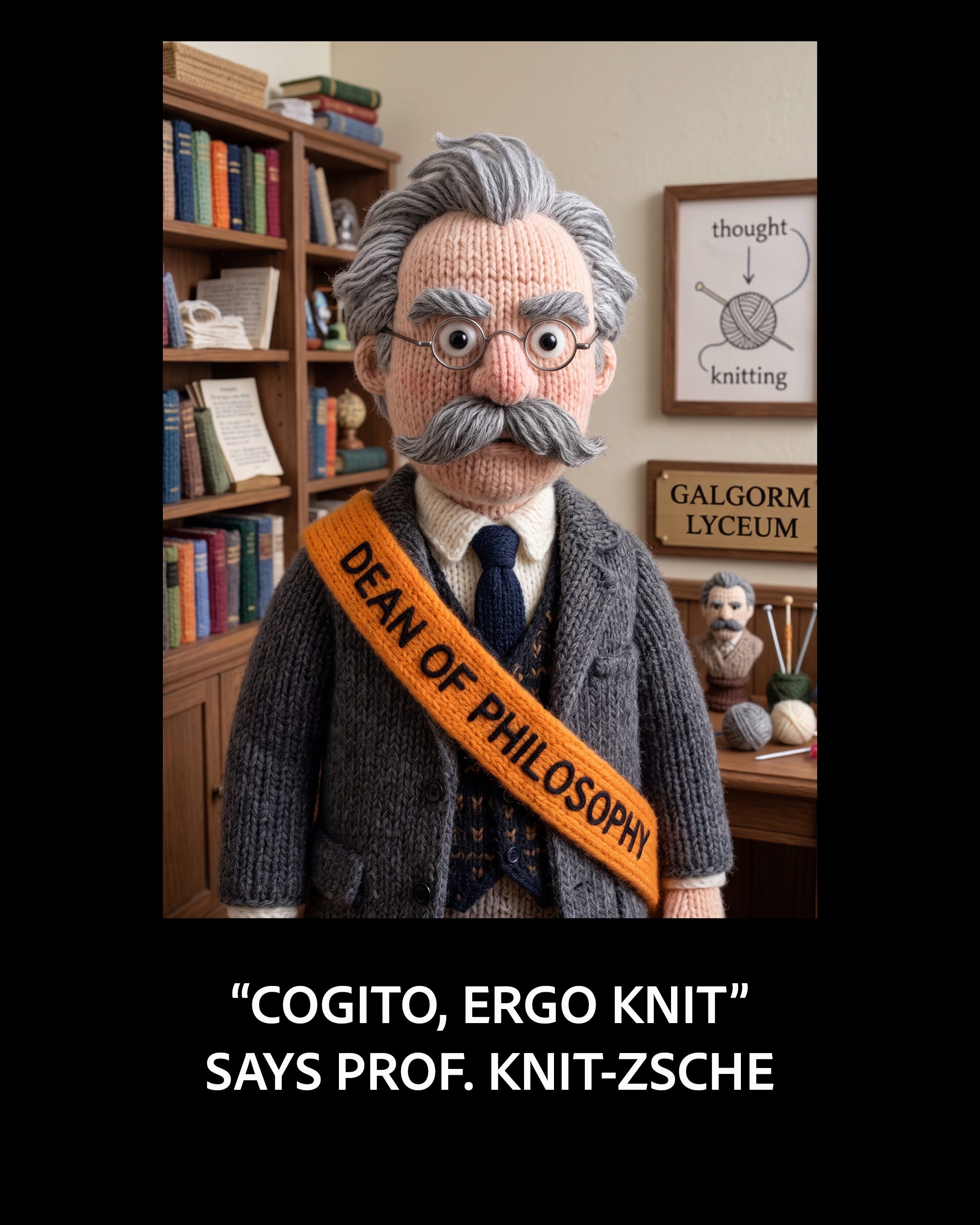
The foundations of Western philosophy may be in need of considerable restitching following an extraordinary claim by Professor Friedrich Knit-zsche FRSG GPhil, Dean of Philosophy at the Galgorm Lyceum.
In a paper presented to colleagues at the Lyceum, the Professor argues that René Descartes’ celebrated proposition Cogito, Ergo Sum, traditionally translated as “I think, therefore I am”, has been fundamentally misunderstood for more than four centuries.
According to Professor Knit-zsche, the correct translation is:
“I think, therefore I knit.”
The Professor contends that Descartes arrived at his philosophical breakthrough during a little-documented visit to Galgorm, where he was introduced to the local art of knitting. It was here, he suggests, that the French philosopher first recognised the essential relationship between thought, existence and the production of woollen garments.
Professor Knit-zsche believes subsequent scholars, unfamiliar with the significance of this discovery, gradually obscured its original meaning through a series of unfortunate translations and academic misunderstandings.
“The evidence is self-evident,” the Professor reportedly explained. “To think is to create. To create is to knit. Therefore, the act of knitting is not merely an occupation but the very foundation of conscious existence.”
The implications of the Professor’s findings are considerable. If accepted, his interpretation could require centuries of philosophical scholarship to be unravelled and carefully restitched.
The Galgorm Lyceum has yet to announce whether the paper will be submitted for wider academic review. However, Professor Knit-zsche remains confident that his research will withstand scrutiny.
For now, one question remains unanswered: if Descartes thought, therefore he knitted, what exactly did he make?
The Professor is understood to be working on a further paper.
The Galgorm Knitted Press will continue to follow developments.